
Experts believe it would be far-fetched to believe that Riyadh would support Pakistan militarily in any conflict with India, which has robust strategic and economic relations with Saudi Arabia.

Two 'very smart' leaders of India and Pakistan decided to end last month's conflict that could have turned into a nuclear war, United States President Donald Trump said after holding a rare luncheon meeting with Pakistan army chief Field Marshal Asim Munir at the White House.
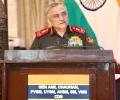
Gen Chauhan said a "whole of the nation" approach will be required to develop the shield.

Trump's method are more destabilising than his policy. So, a good idea these couple of years is to sip Kool-Aid, and savour the joys of Trumplomacy, asserts Shekhar Gupta.
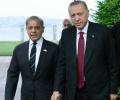
Pakistan Prime Minister Shehbaz Sharif met with Turkish President Recep Tayyip Erdogan to review bilateral relations and reaffirm their commitment to strengthening their strategic partnership. The two leaders discussed joint ventures and enhanced bilateral investment in key sectors, aiming to achieve a $5 billion annual bilateral trade target. They also expressed gratitude for mutual support during recent tensions with India. The meeting was described as "warm and most cordial," highlighting the deep-rooted historical ties between Pakistan and Turkey.

In a statement after a meeting between Trump and Pakistan Army chief Asim Munir at the White House on Wednesday, the Inter-Services Public Relations -- the media wing of the Pakistan Army -- said they also discussed joint counterterrorism efforts.
'Rather than deploying Pakistani nationals or using identifiable cross-border materials, the ISI sought to radicalise and recruit local Indian youth, including well-educated professionals such as doctors.'

Pakistan seized 19 Afghan military posts and "terrorist hideouts" in response to alleged attacks by Afghan forces. Kabul claims significant Pakistani casualties. Tensions escalate following repeated attacks by the Tehreek-e-Taliban Pakistan (TTP).

Flash floods in Pakistan's Khyber Pakhtunkhwa province have resulted in a significant loss of life, with the death toll rising to 327 in the last 48 hours. The disaster has prompted relief efforts from the army and government agencies.

If General Asim Munir, Pakistan's new army chief, wants to help defuse the current polarised atmosphere and shepherd civilian politicians towards negotiations on an acceptable date for elections, he may need to distance himself from any perception of needless hostility to Imran Khan, explains Rana Banerji, who headed the Pakistan desk at RA&W, India's external intelligence agency.
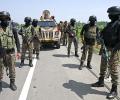
India needs to be technologically and militarily prepared to defend itself from both Pakistan and China, alerts Ramesh Menon.

'Fears in Washington began to intensify when it was realised that subsequent Pakistani and Indian attacks on major military facilities -- which were significant in terms of geographic scope and intensity -- could rapidly take both sides to where neither actually wanted to go.' 'The US objective was to stop the fighting as soon as possible. Everything else was secondary.'

'It is important India to stay focussed on its primary national objectives: Combating terrorism; not losing sight of other security and strategic concerns (on the Sino-Indian front for instance); ensuring a strong economy and registering growth which includes improving the lot of common people; and finally making certain that the social fabric remains intact and harmony among people is not jeopardised, at least any further,' asserts Nilanjan Mukhopadhyay.

India has to fill in all the critical gaps in missiles, ammunition, sensors and stockpile in the fastest possible manner, focusing on the critical instruments that worked this time, asserts Shekhar Gupta.

Trump's new rules for how countries should treat him have led to the current breakdown in India-US relations, explains Ambassador T P Sreenivasan.
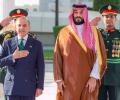
'Saudi-Pak defence pact is to anchor the defence and security of Saudi Arabia and not Pakistan, per se, with Islamabad being the junior partner.'
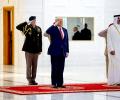
'He is intrigued by the intractability of Kashmir issue. With his interest in dealmaking and peacebrokering, he sees it as an exciting challenge to tackle.'

'The lesson Beijing would have learned is that there is, cost-benefit wise, no better option than to keep the Pakistan military supplied with its most advanced armaments, certain that in hostilities with India these would be used for maximum effect.'
 © 2026 Rediff.com - Investor Information - Advertise with us - Disclaimer - Privacy Policy - Sitemap - Feedback - About us - Terms of use - Grievances